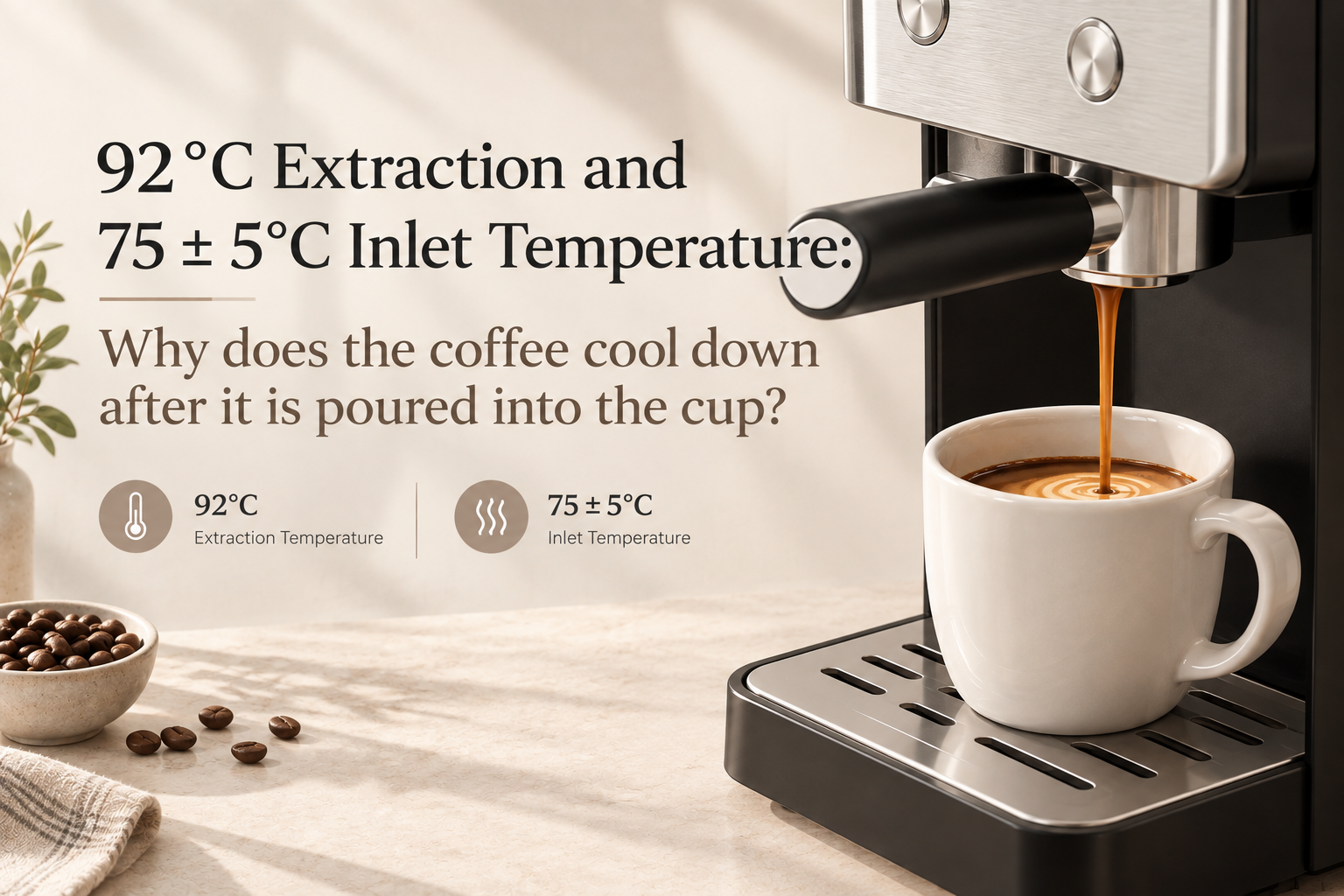
92°C Extraction Temperature Is Not the Same as Cup Temperature
The espresso extraction temperature is the temperature of the brewing water at or near the coffee puck during extraction. In this article, 92°C refers to that extraction target—not the final temperature measured in the serving cup.
Once the espresso leaves the machine, it is no longer thermally protected by the brewing system. Its temperature begins to fall immediately, especially when it comes into contact with cooler metal components, air, and a room-temperature cup.
For this reason, the coffee’s in-cup espresso temperature should not be compared directly with the 92°C machine setting.
Why Does Espresso Cool Down So Quickly?
If you are wondering why does espresso cool down even when the machine is set to 92°C, the answer is normal heat transfer. A small espresso volume loses heat quickly because it has relatively low thermal mass.
The main sources of espresso heat loss include:
- Coffee grounds: Room-temperature coffee grounds absorb heat as hot water passes through the coffee puck.
- Brewing components: The portafilter, filter basket, group head, and coffee outlet can absorb heat if they are not fully preheated.
- Air exposure: Espresso flows in a thin stream, increasing its exposed surface area and allowing heat to dissipate before it reaches the cup.
- The coffee cup: A cold ceramic, glass, or thick-walled cup absorbs heat as soon as espresso is poured in.
- Small beverage volume: A 40–80 ml espresso cools more rapidly than a larger coffee beverage.
What Is the First-Cup Espresso Temperature?
For a 40–80 ml espresso, the first-cup temperature is typically measured immediately after dispensing into a preheated cup.
Under the following test conditions, the expected in-cup espresso temperature is approximately 75 ± 5°C:
| Test Item | Recommended Condition |
|---|---|
| Extraction setting | 92°C |
| Beverage type | Espresso |
| Beverage volume | 40–80 ml |
| Cup condition | Preheated espresso cup |
| Measurement timing | Immediately after dispensing |
| Measurement point | Center of the liquid, without touching the cup wall or bottom |
| Ambient conditions | Room temperature, away from direct cold airflow |
| Expected in-cup temperature | 75 ± 5°C |
A result between approximately 70°C and 80°C can be normal. Actual results may vary with room temperature, cup material, cup thickness, beverage volume, component preheating, and the time between dispensing and measurement.
Why Is the First Espresso Often Cooler?
The first espresso may be cooler because the group head, portafilter, filter basket, coffee outlet, and cup have not yet fully warmed up.
When these parts begin at room temperature, they absorb more heat from the coffee. This is especially noticeable with a small 40–80 ml espresso. After the machine and accessories have been warmed by hot water and previous extractions, later shots may show a more stable in-cup temperature.
How to Reduce Espresso Heat Loss
To improve first-shot consistency and reduce temperature loss:
- Run hot water through the group head before brewing to warm the internal brewing path.
- Preheat the portafilter and filter basket before locking them into the group head.
- Rinse the espresso cup with hot water for 5–10 seconds, then empty it before brewing.
- Serve or measure the espresso immediately after it is dispensed.
- Avoid using cold, thick-walled cups or placing the cup in direct air-conditioning airflow.
- Keep the cup type, beverage volume, room temperature, and measurement timing consistent when comparing results.
Preheating does not mean the espresso will remain at 92°C in the cup. It reduces the amount of heat absorbed by cold components and helps deliver a warmer, more consistent first espresso.
Customer Service Answer
Q: Why is the first espresso about 75°C when the machine is set to 92°C?
A: The 92°C setting refers to the espresso brewing temperature during extraction, rather than the final serving temperature in the cup. Heat is naturally lost as the coffee passes through the coffee puck, filter basket, portafilter, outlet, air, and cup. For a 40–80 ml espresso served in a preheated cup and measured immediately after dispensing, an in-cup espresso temperature of 75 ± 5°C is considered normal.
Work with HUAGUANG on Consistent Espresso Temperature
At HUAGUANG, we support global coffee-machine brands with OEM/ODM development for espresso, capsule, and drip coffee machines. We help partners define practical product specifications and testing methods based on factors such as heating-system design, warm-up performance, beverage volume, cup preheating, and real-world in-cup temperature.
If you are developing an espresso machine and need support with temperature performance, first-cup consistency, customized specifications, or coffee-machine manufacturing, contact HUAGUANG to discuss your OEM/ODM project.