


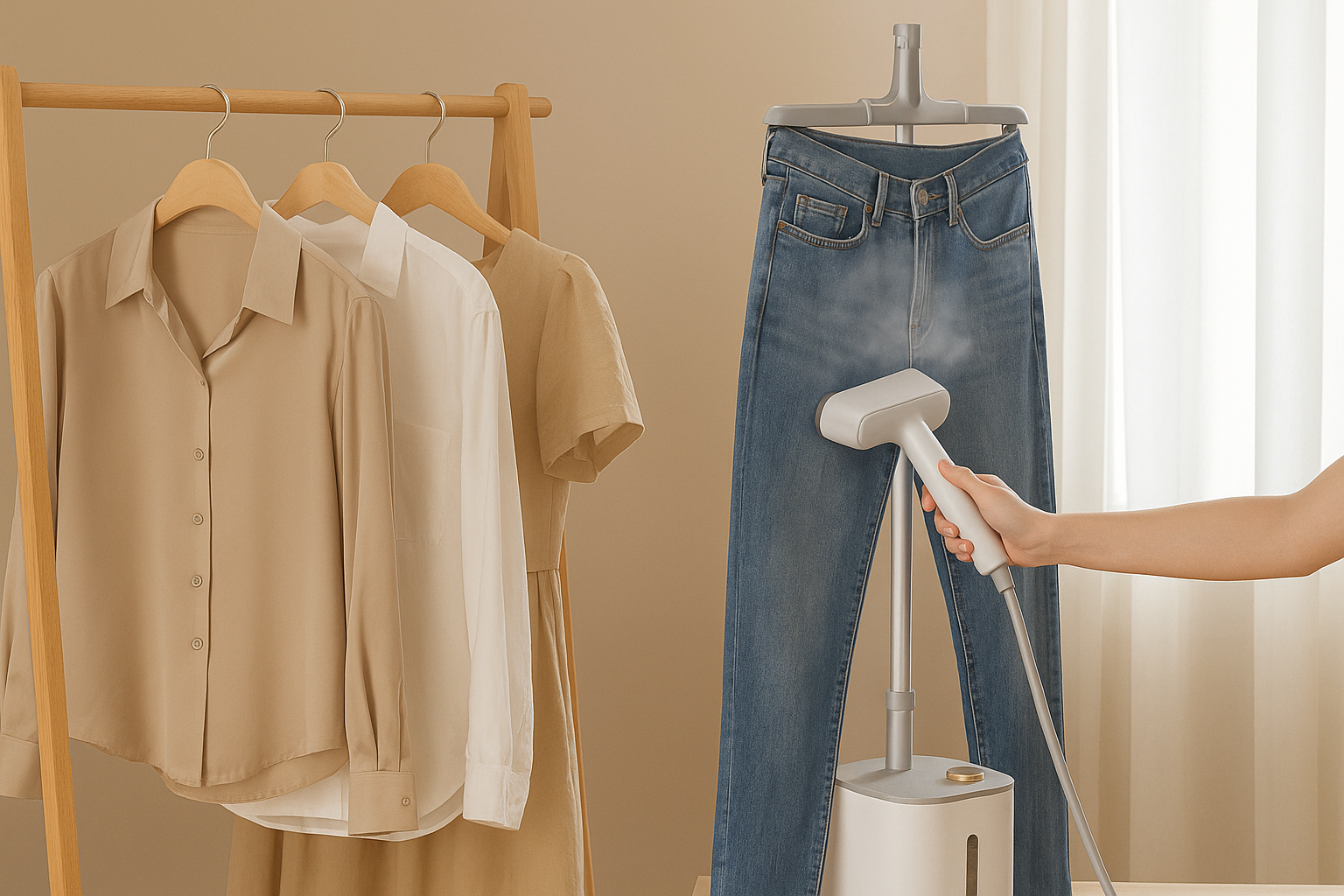
Today, garment care looks different. Compact steamers, standing units with built-in boards, and smart irons make it possible to go from wrinkled to ready in just a few passes—without turning your bedroom into a laundry room. This guide walks through how steaming and ironing work together, and how to choose the right type of steamer for your routine.
Steaming vs. Ironing: When to Use Which
Steaming uses hot vapor to relax fibers. It’s fast, gentle, and ideal when:
- You’re working with delicates like silk, viscose, chiffon, or light wool.
- You want to refresh clothes that smell a bit “closet” but aren’t actually dirty.
- You’re dealing with hanging items—blouses, dresses, curtains, coats—where setting up an ironing board feels like overkill.
Ironing uses direct contact and pressure to reshape fabric. It still wins when:
- You need sharp creases in trousers, pleats, and uniforms.
- You’re working with crisp cotton and linen and want that hotel-sheet finish.
- You’re tailoring or sewing and must press seams flat and precise.
In a perfect world, a home has both: a steamer for speed and volume, and an iron for detail work. Many modern standing steamers now integrate small boards or pressing surfaces so you can switch between “cloud of steam” and “firm press” without swapping tools.
The Specs That Actually Change Your Results
When you look at product pages, it’s easy to get lost in numbers. For day-to-day use, a few specs matter more than the rest:
- Wattage (W)
Higher power usually means faster heat-up and a denser, more stable steam cloud. For everyday home use, 1300–1800 W on a standing unit is a sweet spot; travel and handheld models run a bit lower to stay compact. - Steam Rate (g/min)
This tells you how much steam the appliance can deliver per minute. A higher, consistent rate means you can move faster without going over the same spot again and again. - Heat-Up Time
If you’re dressing on a deadline, sub-30-second start-up on handhelds and a couple of minutes on standing units is a genuine quality-of-life upgrade. - Tank Capacity & Working Time
- Small detachable tanks are perfect for touch-ups and apartments.
- Larger 1–1.7 L tanks on standing steamers give you 30–40 minutes per fill for weekend “reset the closet” sessions.
- Panel / Soleplate Materials
Cast-aluminum or ceramic-coated panels spread heat evenly and glide more safely over different fabrics. They’re less likely to snag or create shiny spots.


