An approved sample shows what a supplier can make. But can every shipment meet the same standard? For buyers sourcing garment steamers, steam irons, or coffee machines, that is where quality control matters—from checking incoming components to verifying steam output, brewing consistency, and finished-product quality.
This guide explains the quality control process in manufacturing, how QC differs from QA, and which inspection steps and records B2B buyers should review before approving their next shipment.
What Is Quality Control in Manufacturing?
Quality control, or QC, is the part of quality management focused on fulfilling quality requirements. In manufacturing, it includes inspecting, measuring, and testing materials, components, and products against defined acceptance criteria.
For a small appliance order, those criteria should cover more than appearance. Buyers and manufacturers should agree on electrical specifications, functional performance, workmanship, labeling, packaging, and applicable safety requirements before production.
The key question is not simply, “Does the factory inspect its products?” It is, “What does it check, against which limits, and what happens when a result fails?”
Quality Assurance vs. Quality Control
Quality assurance and quality control work together, but they serve different purposes. QA establishes confidence that quality requirements will be fulfilled; QC uses operational checks and measurements to verify that those requirements are met.
| Aspect | Quality assurance: QA | Quality control: QC |
|---|---|---|
| Main focus | Systems and processes that support consistent quality | Conformity of materials, processes, and products |
| Typical activities | Procedures, training, supplier qualification, and audits | Inspection, measurement, testing, and defect identification |
| Buyer’s question | Can this supplier consistently follow a reliable process? | Does this batch meet our agreed requirements? |
Auditing belongs to QA, while inspection compares actual characteristics with specified requirements. QC is therefore not limited to a final check after production; it can operate throughout manufacturing.
Why Quality Control Matters to B2B Buyers
Quality control creates decision points: whether to accept incoming components, continue production, rework affected units, or release a shipment. Manufacturers commonly place inspections at incoming, in-process, and final stages.
For buyers, this supports three practical objectives:
- Detect problems earlier. Finding a component issue before assembly can limit the number of finished units affected.
- Verify batch consistency. Inspection records provide evidence beyond the appearance and performance of a single approved sample.
- Make release decisions traceable. Documented results explain why a shipment was accepted, held, or corrected.mrpeasy+1
However, final inspection alone cannot explain where a recurring defect originates. Sampling identifies defects in the inspected sample; process monitoring and investigation are needed to find and address their causes.
The Small Appliance Quality Control Process
The following is a recommended buyer-facing control framework, not a claim that every manufacturer uses identical procedures. Actual checks, frequencies, and limits should be agreed for the model and destination market.
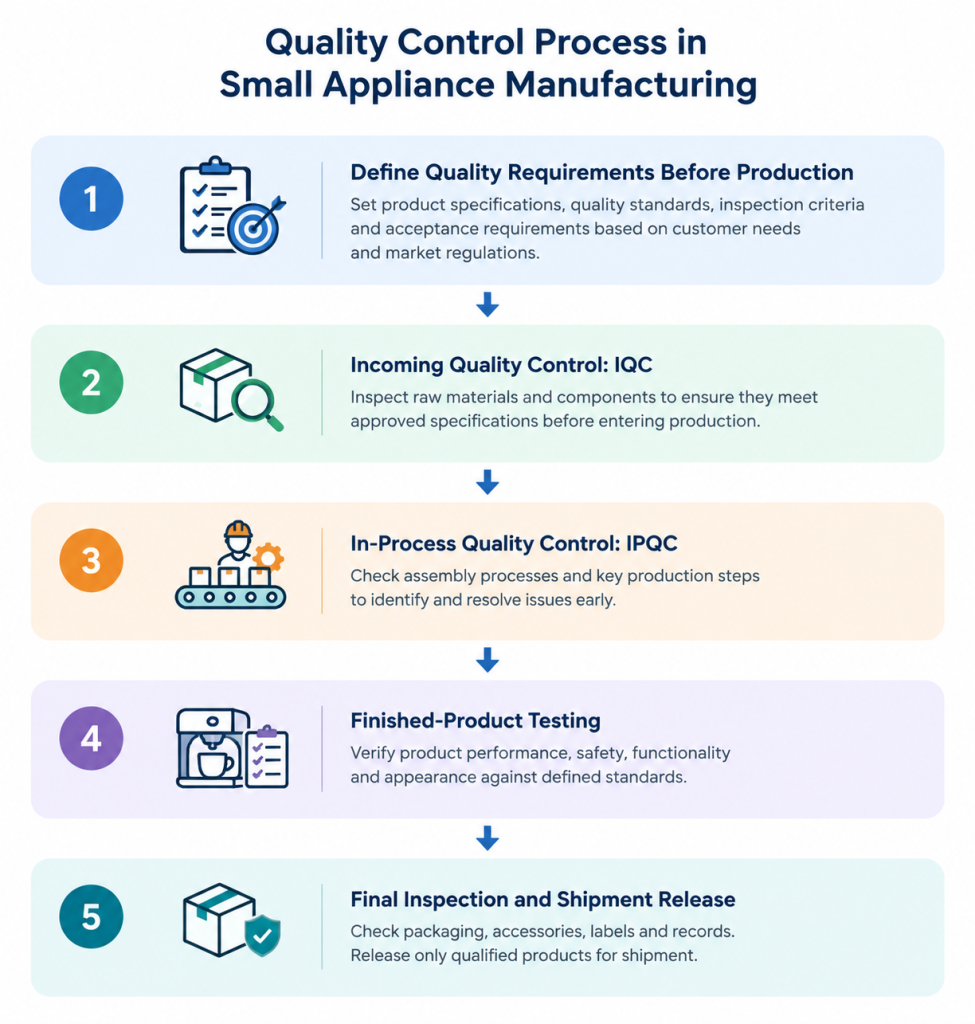
1. Define Quality Requirements Before Production
Prepare a product specification and inspection checklist covering:
- Model, voltage, frequency, rated power, plug, and approved components.
- Performance targets and measurement methods.
- Appearance, dimensions, accessories, and workmanship.
- Packaging, labels, manuals, and batch identification.
- Defect classifications and shipment acceptance rules.
Use an approved reference sample alongside written specifications. Where performance can be measured, record numerical limits rather than relying on descriptions such as “strong steam” or “stable brewing.”
Inspection is meaningful only when measured results can be compared with specified requirements.
2. Incoming Quality Control: IQC
Incoming inspection checks materials and components before they enter production. For steam and coffee appliances, a buyer’s checklist can prioritize:
| Component group | Suggested verification |
|---|---|
| Heaters and thermal protection devices | Approved specification, identification, and relevant test records |
| Pumps, valves, seals, and tubing | Model consistency, dimensions, fit, and leakage checks where applicable |
| Power cords, plugs, and wiring | Correct market configuration and approved component identification |
| Water tanks, housings, and control boards | Dimensions, visible defects, fit, and specified functional checks |
Ask how the supplier identifies and segregates rejected material. A failed incoming inspection should result in a documented disposition, not an informal decision to continue using the parts.
Incoming inspection is one of the standard checkpoints used to prevent unsuitable materials from progressing through manufacturing.
3. In-Process Quality Control: IPQC
In-process checks verify critical operations while products are being assembled. Suggested checkpoints include wiring routing, terminal connections, hose installation, sealing, fastening, and first-piece approval after a setup or component change.
For example, a buyer may request a check of hose connections before the housing is closed, rather than relying solely on a leak test at the end of the line.
Each checkpoint should identify the characteristic being checked, the method, the acceptance limit, the inspection frequency, and the action required after failure. Positioning checks at higher-risk or historically problematic operations makes the inspection plan more targeted.
4. Finished-Product Testing
Finished-product testing should distinguish routine production checks from sample-based performance, durability, and design-validation tests.
The tables below provide suggested inspection-plan items. They are not universal test requirements, and numerical limits must come from the approved specification and applicable test methods. Appliance performance testing may follow national, international, industry, retailer, or buyer-specific requirements.
Garment Steamer Quality Control
| Suggested check | What buyers should define or verify |
|---|---|
| Heat-up time | Time from the specified starting condition to usable steam or the required operating condition |
| Steam output and consistency | Output over a defined interval, with controlled fill level, voltage, and operating mode |
| Leakage and water spitting | Performance during specified operating positions and handling conditions |
| Temperature control | Soleplate temperature and stability for irons; relevant operating temperatures for steamers |
| Protective functions | Operation of fitted features, such as automatic shut-off, using an approved procedure |
| Endurance | Repeated operating cycles, followed by checks for leakage, steam deterioration, or mechanical failure |
Keep garment steamers and irons distinct when confirming safety requirements. IEC 60335-2-85 addresses fabric steamers and explicitly excludes electric irons, which are addressed by IEC 60335-2-3.
Coffee Machine Quality Control
| Suggested check | What buyers should define or verify |
|---|---|
| Water-circuit integrity | Leakage around the tank, pump, tubing, valves, and brewing assembly |
| Heating and temperature consistency | Temperature measured at a defined location using a repeatable procedure |
| Dispensing consistency | Delivered beverage mass or volume across repeated cycles |
| Brewing-system operation | Flow, cycle timing, and pressure where relevant to the machine design |
| Model-specific functions | Capsule insertion and ejection, grinder operation, or milk-system performance, as fitted |
| Endurance and maintenance functions | Repeated brewing cycles and operation of specified cleaning or descaling functions |
Use controlled test conditions when comparing machines. Specify the water, coffee or capsule, settings, warm-up state, and measurement method. Otherwise, differences in the test setup may be mistaken for differences in product quality.
Household coffee makers fall within the scope of IEC 60335-2-15 for appliances that heat liquids. Safety conformity and brewing performance are separate evaluation questions; one should not be presented as proof of the other.webstore.
5. Final Inspection and Shipment Release
Final inspection should verify the finished order against the approved checklist, including workmanship, functions, accessories, labels, manuals, packaging, and quantity.
Where acceptance sampling is used, buyers should agree on the sampling standard, inspection level, defect classifications, and acceptance criteria before inspection. ANSI/ASQ Z1.4 provides an AQL-based acceptance sampling system, including normal, tightened, and reduced inspection plans.
Passing a sample inspection does not prove that every unit is defect-free. Sampling supports a lot-acceptance decision; it does not replace applicable safety testing or process controls.
Which QC Methods Should Buyers Look For?
Different methods answer different questions:
| Method | Main purpose | Procurement application |
|---|---|---|
| Visual inspection and measurement | Check conformity to defined requirements | Workmanship, dimensions, assembly, and labeling |
| Functional and performance testing | Verify operation against agreed specifications | Steam output, heating, dispensing, and controls |
| Acceptance sampling | Decide whether to accept or reject a production lot | Final batch inspection |
| Statistical process control | Monitor variation and identify process changes | Repeated measurements of a critical production characteristic |
| Root-cause investigation and corrective action | Address why a defect occurred | Recurring leakage, inconsistent output, or repeat failures |
Acceptance sampling evaluates a lot, while statistical process control helps monitor the process producing it. They are complementary methods, not interchangeable alternatives.
What to Request Before Approving a Supplier
Use the following as a procurement evidence checklist:
- A model-specific quality control plan with inspection stages, frequencies, and acceptance limits.
- Recent inspection reports showing measured results, not only “pass” marks.
- Calibration or verification records for relevant measuring equipment.
- Applicable safety test reports matching the product configuration.
- An example of a closed nonconformity, including corrective action and follow-up verification.
- Batch traceability linking production records to the shipped order.
- A change-control procedure covering critical components, materials, and software where applicable.
Treat these as documents to review, not boxes to tick. For example, check whether a performance report identifies the tested model, test conditions, method, and results.
Conclusion
Choosing a small appliance manufacturer means looking beyond an approved sample to the controls behind every shipment.
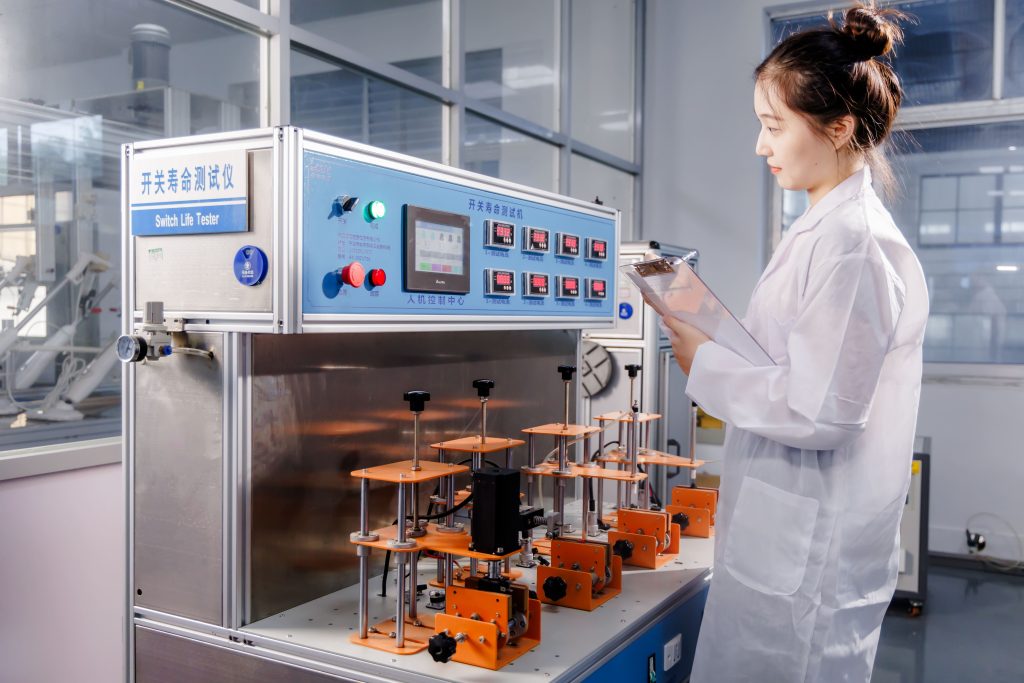
At Huaguang, quality control combines testing capabilities with digital production management. Our Intertek- and SGS-recognized laboratory supports product inspection and testing, and all products intended for sale must complete the required testing procedures and meet specified requirements before shipment.
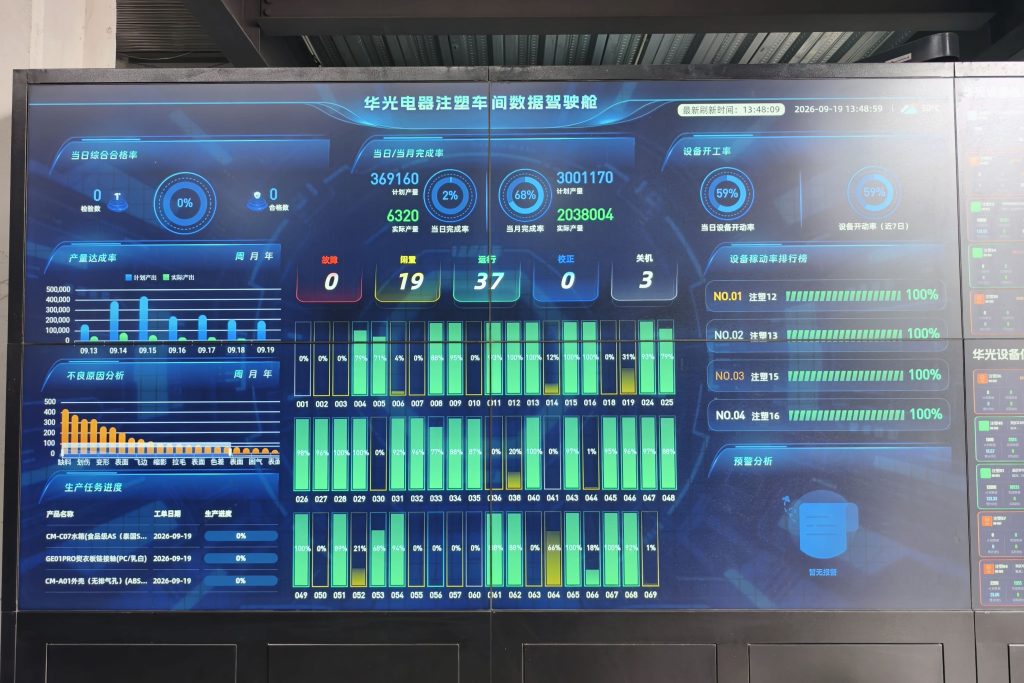
Digital dashboards are deployed throughout our injection molding and production workshops, supporting data-driven monitoring and control across the manufacturing process. Together, these capabilities help us maintain consistent production quality and provide B2B buyers with greater confidence when sourcing garment steamers, steam irons, and coffee machines.